
Your graphics add a nice touch to my presentations and I recently used them for one of my all-hands meetings. Your toolbox adds professionalism to my slides. Instead of using standard clipart.
Claude Jones, Director of Engineer, @Walmartlabs, USA

Your graphics add a nice touch to my presentations and I recently used them for one of my all-hands meetings. Your toolbox adds professionalism to my slides. Instead of using standard clipart.
Claude Jones, Director of Engineer, @Walmartlabs, USA
I needed a fresh look at some of my slides. I've tried to find a way to create a paintbrush effect, to underline, accentuate, add some color and the handwritten markers were just the things. Very easy to use, easy to size, change the color. It was an affordable, perfect solution and I'm happy to recommend it.
Anonymous, US
The crisp, clean look of the graphics, and the fact that it allowed me to easily edit and change the colors to match the template was my main reason for purchasing them.
Brandie Jenkins, E-learning Developer, USA
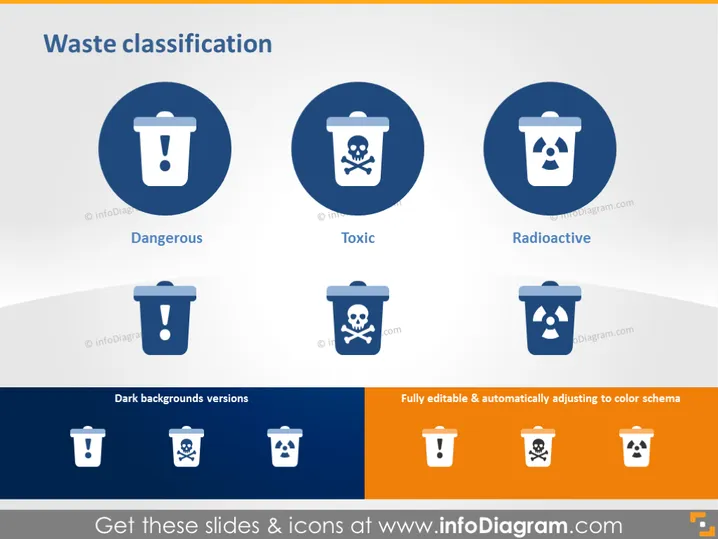
The slide titled "Waste classification" presents three categories of waste, each represented by a circular icon with a trash bin: Dangerous, Toxic, and Radioactive. Dangerous waste is symbolized by an exclamation mark, indicating materials that pose a significant risk. Toxic waste is marked by a skull and crossbones, highlighting its harmful chemical nature. Radioactive waste features the universal symbol for radioactivity, denoting materials that emit ionizing radiation.
The slide is visually balanced, using symmetrical alignment of icons and text to convey information clearly and effectively. The color scheme is limited, focusing on contrast to make the icons stand out.