
Your graphics add a nice touch to my presentations and I recently used them for one of my all-hands meetings. Your toolbox adds professionalism to my slides. Instead of using standard clipart.
Claude Jones, Director of Engineer, @Walmartlabs, USA

Your graphics add a nice touch to my presentations and I recently used them for one of my all-hands meetings. Your toolbox adds professionalism to my slides. Instead of using standard clipart.
Claude Jones, Director of Engineer, @Walmartlabs, USA
I needed a fresh look at some of my slides. I've tried to find a way to create a paintbrush effect, to underline, accentuate, add some color and the handwritten markers were just the things. Very easy to use, easy to size, change the color. It was an affordable, perfect solution and I'm happy to recommend it.
Anonymous, US
The crisp, clean look of the graphics, and the fact that it allowed me to easily edit and change the colors to match the template was my main reason for purchasing them.
Brandie Jenkins, E-learning Developer, USA
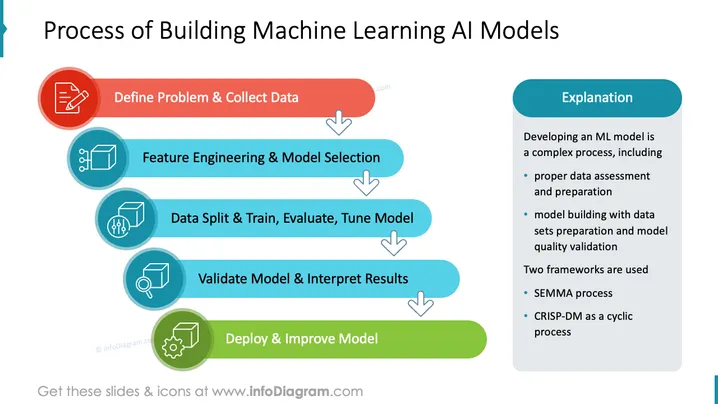
The slide outlines the sequential steps involved in creating machine learning AI models, emphasizing the complexity of the process. Beginning with "Define Problem & Collect Data," where the initial problem is articulated and data is gathered, it moves on to "Feature Engineering & Model Selection," the step where features are engineered for better model performance and an appropriate model is selected. Subsequently, "Data Split & Train, Evaluate, Tune Model" involves dividing the data, training the model, evaluating its performance, and making adjustments to improve it. The fourth step, "Validate Model & Interpret Results," is about confirming the model's accuracy and drawing insights from the outcomes. The final step is "Deploy & Improve Model," where the model is put into practice and continuously refined. The slide also offers an "Explanation" section, which discusses the intricacy of machine learning model development, highlighting proper data assessment and preparation, model building using quality validation, and mentioning SEMMA and CRISP-DM as two key frameworks used in this context.
The slide has a professional and appealing visual design that clearly conveys the machine learning model development process through color-coded steps and descriptive icons.